Are Microsoft’s MAI models good enough for the Industry? Time will tell
At Build 2026, Microsoft announced a new lineup of Microsoft new AI models built entirely in-house, marking a significant step in the company’s push toward proprietary AI development. The MAI models, namely MAI-Thinking-1, a 35B-parameter reasoning model, and MAI-Code-1-Flash, a compact 5B-parameter coding model, represent two distinct use cases: deep reasoning and developer productivity. MAI-Code-1-Flash ships natively within GitHub Copilot and Visual Studio Code, built on Microsoft’s own production data and licensed sources, with a focus on delivering more output using significantly fewer tokens.
Table of Contents
Everything about new AI Models
Discussed below are details about the models released by Microsoft courtesy of Blog post.
MAI-Thinking 1
- MAI-Thinking 1 is Microsoft’s first MAI model based on thinking capabilities, built from scratch for serious math, coding, and enterprise use.
- It has 35 billion parameters.
- It is being only available in Private Preview.
MAI-Code 1 Flash
- MAI-Code-1-Flash is Microsoft’s lightweight coding model.
- It is integrated into GitHub Copilot and VS Code, with rollout starting for individual users in the model picker and Auto picker.
- Microsoft says it was trained end-to-end using clean, appropriately licensed data.
- It supports agentic coding, strong instruction-following, and adaptive thinking.
- Microsoft claims it delivers strong price-to-performance for its size, including up to 60% fewer tokens on harder problems.
MAI Transcribe and Image 2.5
Three more specific Microsoft new AI models were introduced.
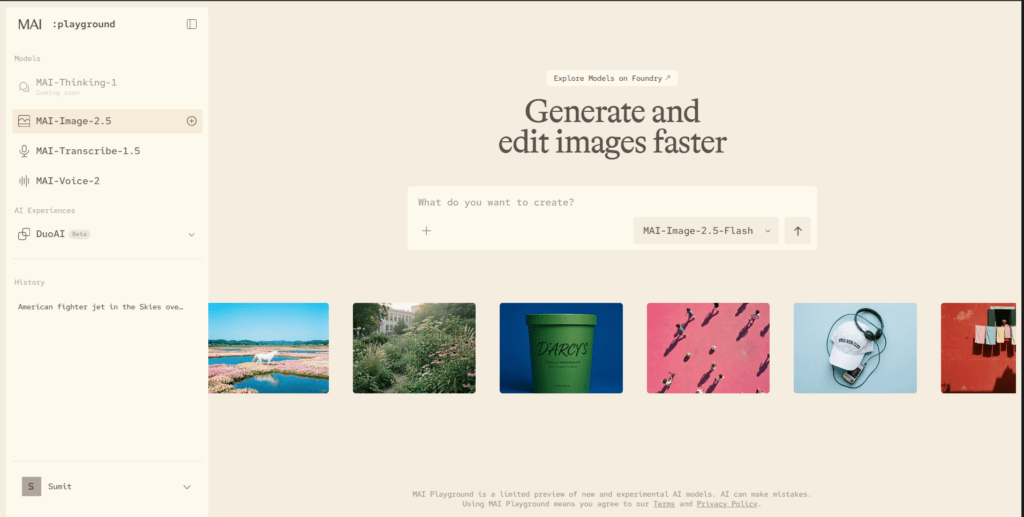
- MAI-Image-2.5 focuses on image generation and editing.
- MAI-Transcribe-1.5 is described as a highly accurate transcription model with support for 43 languages.
- MAI-Voice-2 is the speech generation model, with a lower-cost Flash variant coming soon.
Closing Comments
According to CNBC, Microsoft’s MAI model launches are part of the company’s plan to rely more on its own AI models hosted on Azure, so it can spend less on paying outside providers like OpenAI. This is a growing trend that big cloud companies are building their own models to earn more from AI services and offer tighter, better-suited tools for developers. For those who actually use these models in their work, training on real in-product usage data can make the AI feel more relevant and accurate for everyday tasks, but it also means teams should test these models carefully for issues such as incorrect outputs, data privacy concerns, and response times in live environments.
It will be interesting to see the adoption of this model on GitHub and VS Code, compared to Claude, etc., as these new MAI models seem promising.